

Receiving a driving prohibition in British Columbia can derail your life in an instant. Whether you rely on your vehicle for your commute, your business, or taking your children to school, losing your driving privileges creates immediate hardship. Beyond the inconvenience, driver’s licence suspensions in BC carry severe financial burdens, including towing fees, driver penalty point surcharges, elevated ICBC insurance rates, and potential mandatory rehabilitation programs.
If you or a family member has received a prohibition notice, you do not have to accept a licence suspension without a fight.
Working with an experienced driving prohibition lawyer gives you the best opportunity to challenge the evidence, identify police procedural errors, and protect your driving record. ???? Call us today to schedule a confidential consultation – 604.688.8588 (24hrs)
Time is working against you. In British Columbia, most administrative driving bans carry a strict 7-calendar-day dispute window.
First: Identify What Kind of Prohibition You Received
Not every BC driving prohibition is reviewed in the same way. The legal rules depend on the statutory provision under which the prohibition was issued.
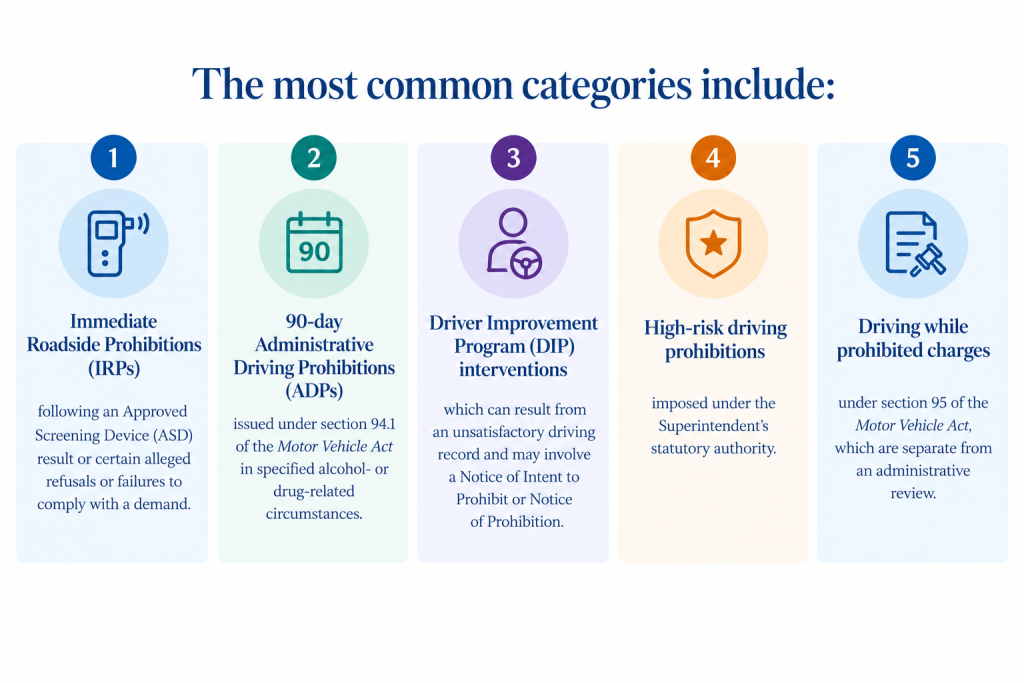 Bcause these processes have different rules, a person should not assume that an argument that applies to an IRP will also apply to an ADP or DIP prohibition.
Driving Prohibitions We Dispute in British Columbia
Driver’s licence suspensions under the BC Motor Vehicle Act (MVA) and the Criminal Code come in several forms. The legal strategy used to challenge a prohibition depends entirely on the specific statutory section under which it was issued.
Immediate Roadside Prohibitions (IRP)
An Immediate Roadside Prohibition (IRP) is typically issued by police following a roadside breath test using an Approved Screening Device (ASD).
| Type | Consequences |
|---|---|
| WARN Reading (0.05 to 0.08 BAC) | Triggers a 3, 7, or 30-day prohibition depending on your prior driving record. |
| FAIL Reading (Over 0.08 BAC) or Refusal | Triggers an immediate 90-day driving prohibition, a 30-day vehicle impoundment, driver training requirements, and steep monetary surcharges. |
Administrative Driving Prohibitions (ADP)
An Administrative Driving Prohibition (ADP) is a 90-day suspension issued under Section 94.1 of the Motor Vehicle Act. ADPs generally arise from impaired driving investigations involving official breathalyzer tests at a police station, blood-alcohol concentration (BAC) lab results exceeding 80 mg/100 mL, Drug Recognition Expert (DRE) evaluations, or sample refusals.
Need detailed answers regarding a 90-day ADP notice?
ADPs involve specific evidentiary requirements, including sworn officer reports and lab analysis certificates. Read our detailed guide on FAQs About Administrative Driving Prohibitions in BC to learn how these reviews operate.
Superintendent Point Bans & Driver Improvement Program (DIP)
The Superintendent of Motor Vehicles regularly issues driving prohibitions to drivers who accumulate excessive driver penalty points or high-risk traffic violations (such as excessive speeding or distracted driving). If you receive a Notice of Intent to Prohibit in the mail, you have a limited window to submit written legal arguments requesting a cancellation or reduction of the ban based on driving history and personal hardship.
Driving While Prohibited: Section 95 of the BC Motor Vehicle Act
Driving while prohibited is a separate offence from the administrative prohibition itself. If you drive knowing that you are prohibited from driving, section 95 of the Motor Vehicle Act creates a criminal-like provincial offence with significant consequences.
| Conviction | Penalties |
|---|---|
Penalties for a first conviction |
For a first conviction under section 95(1), the current Motor Vehicle Act provides for:
A first conviction does not carry the mandatory 14-day jail minimum described in some summaries of the offence. That minimum applies to a subsequent conviction. |
Penalties for a subsequent conviction |
For a subsequent conviction, section 95(1) provides for:
|
The Motor Vehicle Act also provides for a separate driving prohibition following conviction. The applicable consequences depend on the circumstances and the relevant statutory provisions, so a lawyer should review the charge, the underlying prohibition and the driver’s prior record rather than relying on a generic penalty summary.
Do not drive while a prohibition is under review
An application to review an IRP or ADP does not automatically give you permission to drive. The fact that you have challenged a prohibition is not, by itself, a defence to a later allegation of driving while prohibited.
If you are uncertain whether your prohibition is still in force, confirm your legal status before driving.
???? Call us today to schedule a confidential consultation – 604.688.8588 (24hrs)
If you have been charged under section 95
A section 95 charge is different from an administrative review. It is dealt with in the court system and can create consequences beyond the original prohibition.
The appropriate defence depends on the prosecution’s evidence, the status of the underlying prohibition, what the driver knew, and the circumstances in which the vehicle was driven. A lawyer should review the charge and disclosure before advising on available defences or resolution options.
The 7-Day Deadline to Challenge a BC Driving Prohibition
If you have received an Immediate Roadside Prohibition (IRP) or an Administrative Driving Prohibition (ADP), the first issue is the deadline.
For an ADP issued under section 94.1 of the Motor Vehicle Act, you generally have 7 days after being served with the notice to apply for a review. Section 94.4 sets out the review process and requires the application to be filed in the required form and manner, with the applicable fee.
An IRP issued under section 215.41 is also subject to a 7-day review deadline under section 215.48. The Act provides that the application must be made within 7 days of service, and the applicant must comply with the required filing and fee requirements.
????Read our article about impaired driving here
What the 7-day deadline means
The deadline is not the deadline for submitting every piece of evidence you may eventually rely on. It is the deadline to apply for the statutory review. Once the review is properly started, the applicable process determines when further written evidence or submissions must be provided.
For IRP reviews, RoadSafetyBC’s published guidelines state that the applicant bears the burden of proof and that the information submitted should address the specific grounds relied upon in the review.
Filing a review does not automatically let you drive
Applying for a review does not, by itself, stay the prohibition. Section 94.4 expressly provides that filing an ADP review does not stay the prohibition, and the statutory IRP review provisions likewise provide that the prohibition takes effect immediately and remains in effect unless revoked or otherwise dealt with under the Act.
That means you should not assume that you can legally drive simply because a review application has been filed.
What to do before the deadline
If you intend to challenge the prohibition:
- Identify exactly what type of prohibition you received. IRPs, ADPs and other prohibitions have different statutory provisions and review procedures.
- Record the date and method of service. The 7-day review period runs from service of the notice.
- Obtain and preserve the notice and related paperwork. Do not rely on memory about what the officer told you.
- Review the evidence and identify the statutory grounds available to you.
- File the review within the applicable deadline and comply with the required fee and filing requirements.
- Do not drive unless you are legally entitled to do so.
Because missing the statutory deadline can prevent a review from proceeding, anyone considering a challenge should obtain legal advice promptly rather than waiting until the final day.
What a BC Driving Prohibition Lawyer Reviews
A RoadSafetyBC review is not simply an opportunity to explain that losing your licence would create financial or personal hardship. The applicable legislation establishes specific review procedures and grounds, and the evidence available in your particular case matters.
A lawyer reviewing an IRP or ADP should begin by identifying which statutory provision created the prohibition and what the reviewing decision-maker is required to determine. That determines what evidence is relevant and what arguments can realistically be made.
Reviewing the police evidence
Depending on the type of prohibition, the review may involve documents such as the prohibition notice, the officer’s report, records concerning an Approved Screening Device (ASD), certificates of analysis, or other prescribed material.
For example, the Motor Vehicle Act requires a peace officer serving an ADP notice to forward specified material to the Superintendent, including the notice, certificate of service, a sworn or solemnly affirmed report, and, where applicable, a certificate of analysis.
For an IRP, the legislation and review materials establish specific evidentiary issues that can arise from an ASD result, including whether the statutory requirements for the prohibition were met. The legislation also provides specific outcomes where the Superintendent is satisfied about matters such as the driver’s status or the ASD result.
Identifying the actual review issue
A useful legal review should therefore ask questions such as:
- Was the correct statutory provision used?
- Was the notice properly served?
- Does the evidence establish the facts required by the applicable section?
- What does the officer’s report actually say?
- Are there inconsistencies between the notice, report and other evidence?
- Where an ASD result is relied upon, does the available evidence address the statutory requirements concerning the device and result?
- If a refusal or failure to comply with a demand is alleged, does the evidence support that allegation and are any statutory exceptions relevant?
- What evidence can the driver provide to address the applicable ground of review?
The answer will depend on the prohibition and the evidence in the individual case.
Evidence and written submissions matter
The applicant should focus evidence on the issues that the Superintendent is legally required to decide. RoadSafetyBC’s published IRP review guidelines state that the burden of proof is on the applicant and that submissions should focus on the specific grounds selected for the review.
That can make the difference between a submission that simply describes hardship and one that addresses the statutory test directly.
We are available 24/7 to review your Notice of Prohibition, assess the deadline, and begin building your defence. Contact us today for a free, confidential initial consultation before your 7-day dispute window closes.
When constitutional issues may matter
Some driving-prohibition cases may also raise questions concerning police conduct, detention, the right to counsel, or the circumstances in which a demand or sample was obtained. Whether such an issue is relevant—and what remedy may be available—depends on the facts and the particular proceeding.
For that reason, constitutional arguments should be assessed against the actual police evidence and the governing legislation rather than presented as generic reasons why a prohibition should be cancelled.
Why the notice itself matters
Do not assume that every driving prohibition can be challenged in the same way. An IRP, an ADP, a point-based prohibition and a criminal driving charge arise under different legal provisions and can involve different decision-makers and procedures.
The first step is therefore to identify the exact prohibition you received, calculate the applicable deadline, and review the evidence before deciding which arguments to advance.
Frequently Asked Questions About BC Driving Bans
Can I get a work permit or temporary driver’s licence during a prohibition in BC?
No. British Columbia does not issue “hardship” or “work” licences for administrative driving prohibitions like IRPs or ADPs. Your only option to retain your driving privileges is to successfully challenge and revoke the prohibition through RoadSafetyBC.
What happens if I win my RoadSafetyBC review?
If RoadSafetyBC revokes your driving prohibition, your driving privileges are restored immediately. Depending on the outcome, ICBC may reimburse certain towing and storage fees, and the prohibition will be removed from your driving record.
Contact a Vancouver Driving Prohibition Lawyer Today
Do not let a driving prohibition compromise your livelihood or future. The defence team at Mickelson, Whysall & Moore Law Group brings decades of courtroom and administrative review experience to every case.
- Call Us 24/7: 604-688-8588
- Office Location: Downtown Vancouver (serving Richmond, Surrey, Port Coquitlam, Langley, and across BC)
????Learn more about driving offences in BC and how we can help you
???? Call A Vancouver Lawyer Now – 604.688.8588 (24hrs)
We commit to writing accurate and trustworthy articles showcasing first-hand experience. Our lawyers, highly experienced in driving offences, are fact-checking and approving every piece of content the team creates. If you have a question about any information you read, please give us a call on 604-688-8588
